Prestressed pulmonary artery fluid-solid interaction: pulmonaryArteries
Prepared by Conor Moore
Tutorial Aims
- Demonstrate a patient-specific vascular fluid-solid interaction simulation using
solids4foam. - Demonstrate the prestress functionality in
solids4foam: computing the prestress of an imaged, loaded vessel wall with theupdatePrestressutility, and applying it in a fluid-solid interaction simulation. - Demonstrate a finite-strain arterial wall using the
isotropicFungElasticmechanical law. - Demonstrate fluid and arterial-wall mesh generation using
cartesianMeshandextrudeMesh.
Case Overview
This case models pulsatile blood flow and compliant-wall deformation in the main pulmonary artery and its proximal branches. The geometry is based on model h08 [1], and has one inlet and eleven outlets.
The parameter values in this case are representative only. The wall thickness, wall stiffness, inflow waveform, outflow (Windkessel) parameters and their distribution between the outlets, and the prestress pressure are taken from the literature or chosen for illustration; none is specific to the subject whose geometry is used. The case demonstrates the numerical workflow and is not intended as a clinically validated prediction.
Blood
Blood is represented as an incompressible, shear-thinning fluid with a density of \(1060\,\mathrm{kg\,m^{-3}}\), using the Carreau-Yasuda model (BirdCarreau in constant/fluid/transportProperties) with a zero-shear viscosity of \(0.16\,\mathrm{Pa\,s}\), an infinite-shear viscosity of \(3.5\times10^{-3}\,\mathrm{Pa\,s}\), \(\lambda = 8.2\,\mathrm{s}\), \(n = 0.2128\) and \(a = 0.64\) [2]. The flow is laminar.
Inflow and outflow
A representative pulmonary artery flow-rate waveform, constant/fluid/inletFlow/humanFlow, is prescribed at the inlet with flowRateInletVelocity. Its period is \(0.86\,\mathrm{s}\), its mean \(3.95\,\mathrm{L\,min^{-1}}\) and its peak \(272\,\mathrm{mL\,s^{-1}}\) at \(t = 0.13\,\mathrm{s}\) [1].
Each outlet uses a three-element Windkessel condition (windkesselPressure in 0/fluid/p) to represent the downstream pulmonary vasculature. The total proximal resistance \(R_p = 3.3\times10^{6}\,\mathrm{Pa\,s\,m^{-3}}\), distal resistance \(R_d = 2\times10^{7}\,\mathrm{Pa\,s\,m^{-3}}\) and compliance \(C = 3.5\times10^{-8}\,\mathrm{m^3\,Pa^{-1}}\) are based on figures for a healthy person [3]. These values are split between the outlets by a flow fraction proportional to the outlet area, \(f_i = r_i^2 / \sum_j r_j^2\) [4]:
Rch_i = Rp/f_i R_i = Rd/f_i C_i = C*f_i
so that a larger outlet has a lower resistance and a higher compliance, and the outlets in parallel add back up to the totals. The flow fraction of each outlet is noted beside its entry in 0/fluid/p.
Arterial wall
The arterial wall has a uniform thickness of \(1.5\,\mathrm{mm}\) [8], discretised with three cells through the thickness, and a density of \(1200\,\mathrm{kg\,m^{-3}}\). It is represented by the finite-strain isotropicFungElastic law,
W = 0.5*c*(exp(a*tr(Ebar & Ebar)) - 1) + U(J)
with \(c = 7.87\,\mathrm{kPa}\), \(a = 7.05\) and a bulk modulus \(K = 1\,\mathrm{MPa}\). The small-strain shear modulus is \(\mu = c\,a/2 \approx 27.7\,\mathrm{kPa}\).
The values of \(c\) and \(a\) were obtained by fitting this isotropic, three-dimensional law to a planar biaxial (membrane) Fung fit of pulmonary artery tissue, \(c = 15\,\mathrm{kPa}\), \(c_{\theta\theta} = c_{zz} = 6\), \(c_{\theta z} = 1.8\) [8]. The membrane constants cannot be used directly in a three-dimensional law, because the membrane fit does not include the through-thickness strain, so the fit is made under the conditions of the test: plane stress and incompressibility, over biaxial stretch ratios of 1:1, 1:0.75 and 0.75:1, up to a stretch of 1.3. The isotropic law matches the membrane stresses to within about 1% RMS over this range.
The bulk modulus is a penalty that keeps the wall nearly incompressible (small-strain Poisson's ratio of about 0.486). Larger values make the wall closer to incompressible, but slow the linear solver considerably: with \(K = 100\,\mathrm{MPa}\) each load step of the prestress run needed over 3000 linear iterations.
The inlet and outlet rings of the wall are fixed (fixedDisplacement), and the outer wall is traction-free. The surrounding tissue is not represented; it could be added with solidSpringDashpot on outerWall, as in the cerebralAneurysm tutorial.
Case Structure
The tutorial directory is the fluid-solid interaction case, with the solid-only prestress case in prestress/:
pulmonaryArteries/
├── Allrun, Allclean, Allmesh     run, clean and mesh the tutorial
├── 0/, constant/, system/        the fluid-solid interaction case
├── plotInletVsPressure.gplt      inlet flow and probe pressure plot
├── regressionTest.sh             shortened run checked against references
├── Alltest                       smoke test, run by tutorials/Alltest
└── prestress/
    ├── Allrun, Allclean          prestress passes
    ├── petscOptions.hypre        PETSc options for the prestress runs
    └── 0/, constant/, system/    the solid-only prestress case
The wall material is defined once, in constant/solid/mechanicalProperties; prestress/Allrun copies it into the prestress case, so that the prestress is computed with the same material that the fluid-solid interaction run uses.
Mesh Generation
The vascular surface, constant/triSurface/h08_capped.fms.gz, is in millimetres. It is stored compressed; OpenFOAM reads the .gz file directly, so system/meshDict names it h08_capped.fms.
Allmesh creates the meshes:
cartesianMeshgenerates the fluid mesh fromsystem/meshDict, with a maximum cell size of \(1.4\,\mathrm{mm}\), one boundary layer, and \(0.7\,\mathrm{mm}\) refinement around the two smallest outlets.- The arterial wall is extruded outwards from the fluid
wallpatch byextrudeMeshandsystem/extrudeMeshDict, giving three cells across the \(1.5\,\mathrm{mm}\) thickness. The exposed inner face isinnerWall, andcreatePatchwithsystem/createPatchDict.solidrenames the outer faceouterWall. transformPointsscales both meshes from millimetres to metres.- The solid mesh is copied to
prestress/constant/polyMesh.
The fluid mesh has about 87,000 cells and the solid mesh about 69,000.
Minimal root-level fvSchemes and fvSolution dictionaries are included because extrudeMesh and createPatch require them; the simulation uses the region dictionaries under system/fluid and system/solid.
Prestress
Medical images show the artery while it is loaded by the blood pressure, so the imaged geometry is not stress-free. If it is treated as stress-free, the first part of the simulation inflates it beyond the imaged shape. The prestress, Fpre, is a deformation gradient field which, applied to the imaged geometry, puts the wall in equilibrium with the imaging pressure at zero displacement. The deformation gradient seen by the mechanical law is then \(\mathbf{F}\,\mathbf{F}_{pre}\).
Fpre is found with a modified updated Lagrangian formulation (MULF) [5]. The prestress case, prestress/, applies a pressure of \(10\,\mathrm{mmHg}\) (\(1333\,\mathrm{Pa}\)) to innerWall in a steady-state solid-only simulation, and prestress/Allrun repeats the following pass:
- Run
solids4Foamto equilibrium under the pressure. - Run
updatePrestress, which composes the deformation gradient of the run with theFprethat the run used, \(\mathbf{F}_{pre} \leftarrow \mathbf{F}\,\mathbf{F}_{pre}\), writes it to0/Fpreand removes the later time directories, so that the next pass starts again from the imaged geometry with zero displacement.
The first pass runs with prestress no in mechanicalProperties, and ramps the pressure up from zero (constant/timeVsPressure.ramp). The later passes run with prestress yes, and apply the full pressure from the start (constant/timeVsPressure.full) in a single load step (deltaT is changed from 0.25 to 1 in system/controlDict): the wall then already carries the prestress, which balances the full pressure, and ramping the pressure again would first deflate the prestressed wall, which the solver does not converge through. prestress/Allrun restores deltaT 0.25 when it exits.
Each pass appends a line to prestress/prestressHistory, with the convergence measures of the run that used the previous Fpre:
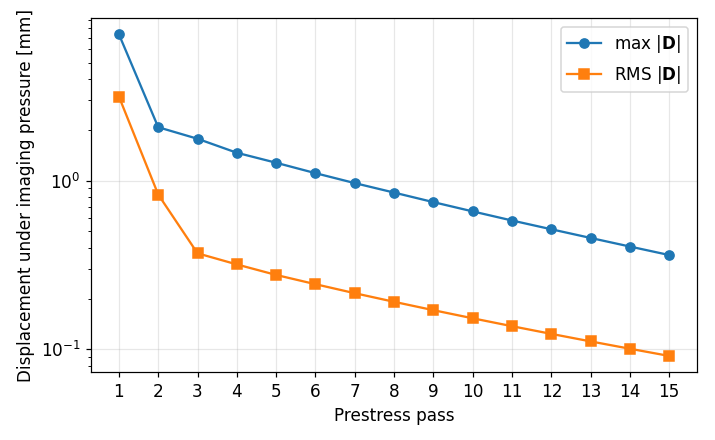
maxMag(D)andrmsMag(D): the maximum and volume-weighted RMS displacement, i.e. how far the loaded wall still moves from the imaged geometry. Both tend to zero asFpreconverges.maxMag(F-I): the largest deviation of the deformation gradient from the identity. This includes rigid rotation, so it can remain large where the wall turns but hardly strains.
The tutorial runs a fixed 15 passes. The convergence is gradual, roughly 15 to 20% reduction in maxMag(D) per pass for this case. For another case, use these measures to choose the number of passes, or a tolerance on maxMag(D), to suit the accuracy required. prestress/Allrun finally copies Fpre to 0/solid/Fpre.
The prestress pressure of \(10\,\mathrm{mmHg}\) is representative; it should be the pressure at the time of imaging. The fluid-solid interaction case starts from the same pressure: 0/fluid/p initialises the internal field and the Windkessel outlets at \(10\,\mathrm{mmHg}\), so the prestressed wall starts in equilibrium.
Numerical Approach
- Fluid: incompressible non-Newtonian laminar flow using
pimpleFluid, with mesh motion byvelocityLaplacianandquadratic inverseDistancediffusivity from the wall. - Solid: total Lagrangian, finite-strain formulation (
nonLinearGeometryTotalLagrangianTotalDisplacement) with theisotropicFungElasticlaw, solved with PETSc SNES using a Jacobian-free Newton-Krylov (JFNK) approach [7], with Rhie-Chow stabilisation. The fluid-solid interaction run preconditions the linear solves with block Jacobi and LU (system/solid/fvSolution); the prestress runs use HYPRE BoomerAMG (prestress/petscOptions.hypre). - Coupling: partitioned fluid-solid interaction using fixed relaxation with a relaxation factor of 1.0 and a Robin pressure boundary condition (
elasticWallPressurewith thesecanthsModel), which provides the stability required by the strongly coupled blood-wall system [6]. The outer-loop tolerance is \(10^{-5}\), the Robin pressure and flux tolerances are \(10^{-2}\), and up to 30 FSI correctors are permitted per time step. - Interface:
wallin the fluid region andinnerWallin the solid region. - Duration: five cardiac cycles,
endTime 4.3, with a fixed time step of \(2.5\times10^{-4}\,\mathrm{s}\) (17,200 time steps). The inlet waveform usesoutOfBounds repeat, so it repeats for each cycle. The Windkessel outlets take about two cycles to settle from their initial pressure (their time constant is \(R_iC_i = R_dC = 0.7\,\mathrm{s}\)), so the later cycles are the periodic, representative ones.
Expected Results
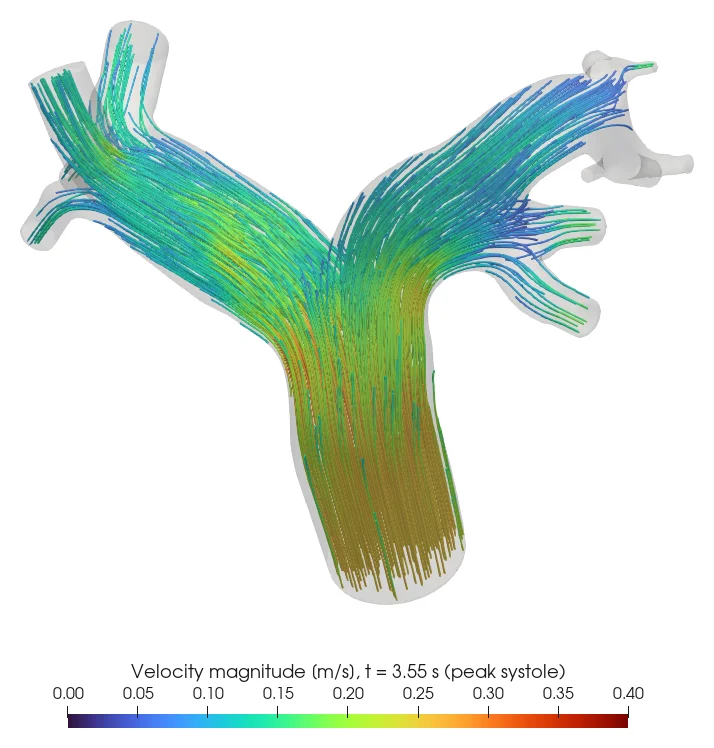
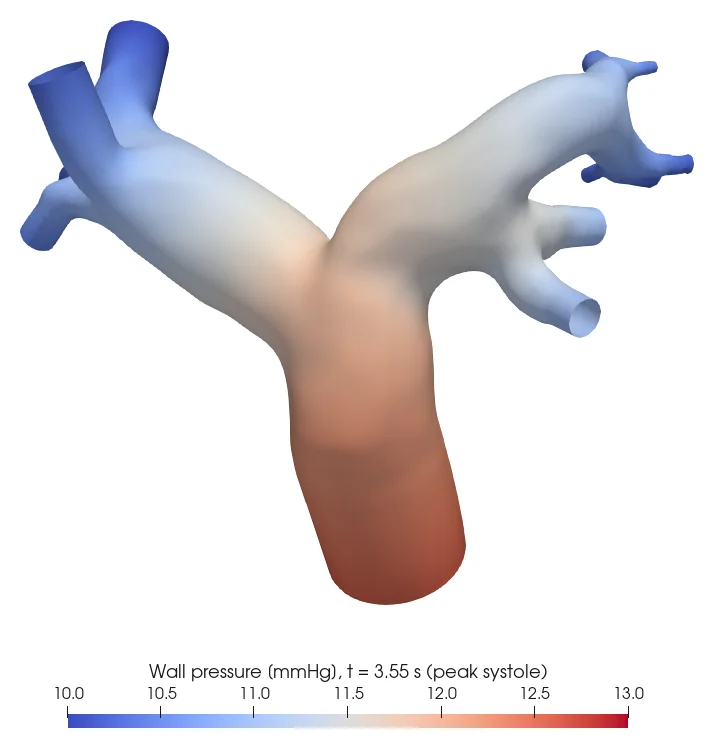
The results below are from the full run of the tutorial: 15 prestress passes and five cardiac cycles on 16 cores. The field images are shown in the fifth cycle, at the write time nearest the peak inflow (\(t = 3.55\,\mathrm{s}\), \(0.11\,\mathrm{s}\) into the cycle), unless stated otherwise.
Prestress convergence
The displacement of the wall under the imaging pressure falls with each prestress pass (prestress/prestressHistory). The first pass, without prestress, moves the wall by up to \(7.4\,\mathrm{mm}\); after 15 passes the largest displacement is \(0.36\,\mathrm{mm}\) and the RMS displacement \(0.09\,\mathrm{mm}\).
Flow and pressure
The blood accelerates from the main pulmonary artery into the left and right pulmonary arteries, reaching about \(0.39\,\mathrm{m\,s^{-1}}\) at peak inflow.
The wall pressure falls from about \(12.7\,\mathrm{mmHg}\) at the inlet to about \(10\,\mathrm{mmHg}\) at the outlets at peak inflow.
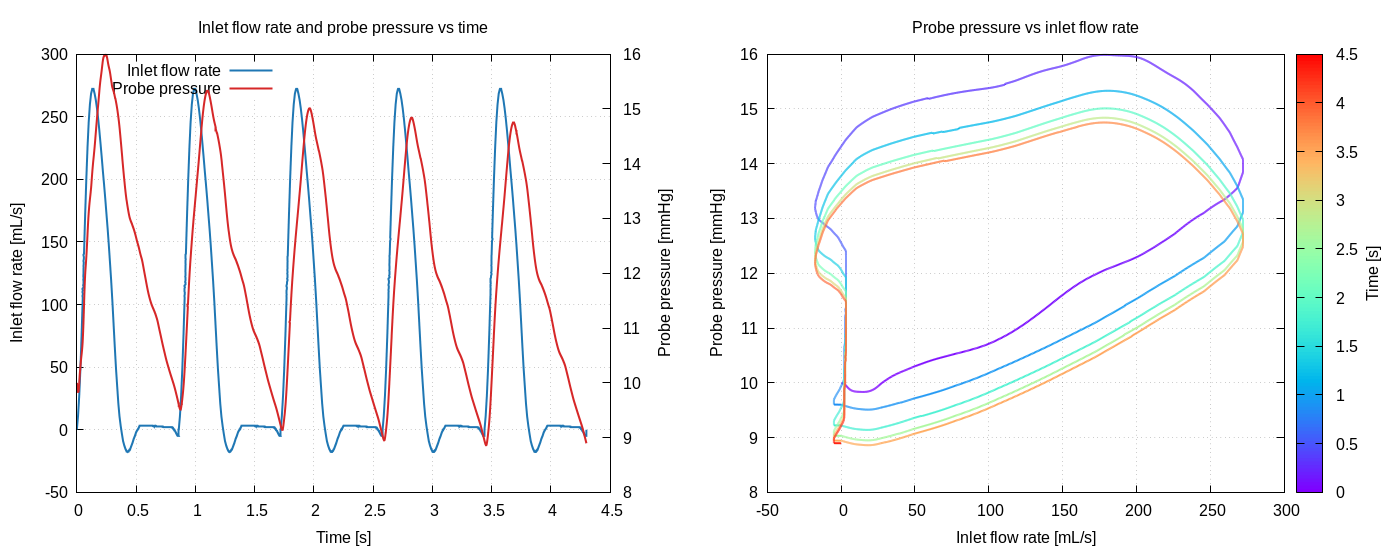
The pressure at a probe in the main pulmonary artery (\((0.04, -0.008, 0.065)\,\mathrm{m}\)) is written every time step to postProcessing/pressureProbe/fluid. When gnuplot is installed, Allrun plots it against the inlet flow rate with plotInletVsPressure.gplt, giving inletFlow_vs_probePressure.png: both against time, and the pressure-flow loop. The first cycle starts from the uniform initial pressure of \(10\,\mathrm{mmHg}\), and the loops settle over the following cycles as the Windkessel outlets approach their periodic state; the fourth and fifth cycles are close to each other.
Wall shear stress
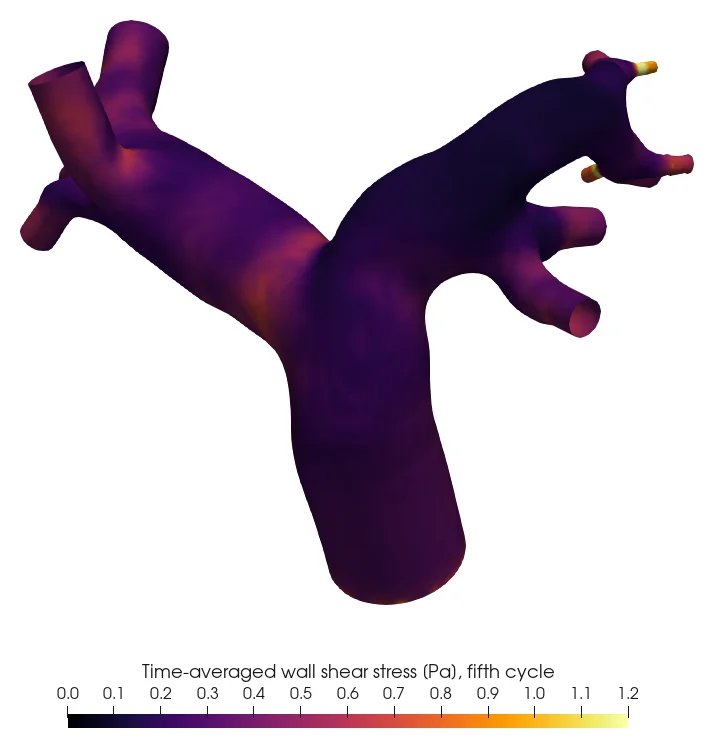
The wall shear stress is written at each write time (\(0.05\,\mathrm{s}\)). The time-averaged wall shear stress over the fifth cycle, averaged from these 17 write times, is mostly below \(0.5\,\mathrm{Pa}\), with higher values in the smallest outlet branches and near the bifurcation.
Wall displacement
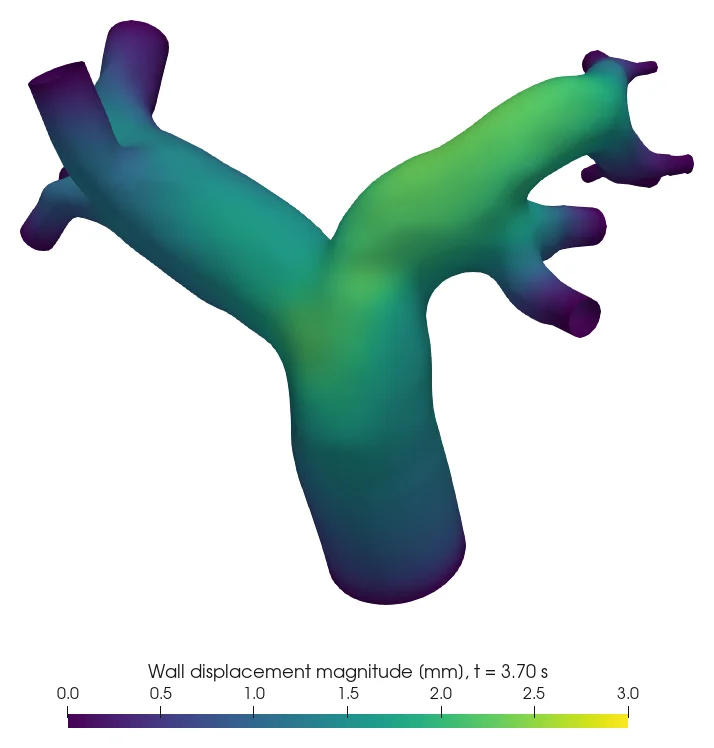
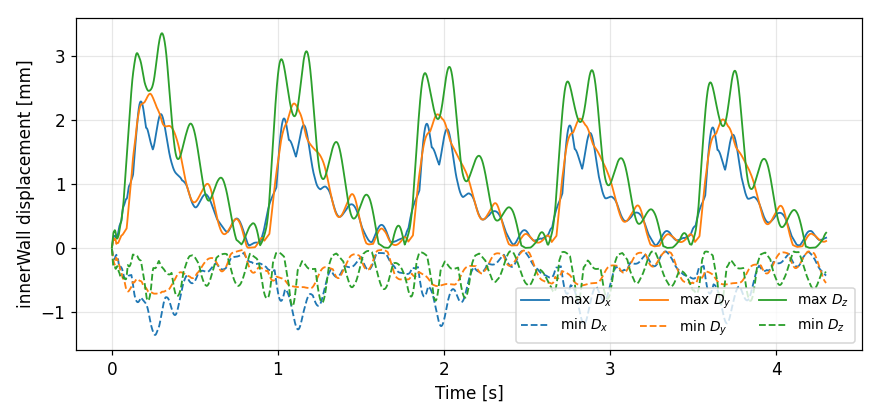
The innerWall displacement is largest in the larger of the two pulmonary branches (right of the image) and at the bifurcation, shown here at \(t = 3.70\,\mathrm{s}\), near the largest lumen volume of the cycle; the fixed inlet and outlet rings do not move. The range of the innerWall displacement components is written every time step to postProcessing/0/solidDisplacementsinnerWall.dat. The largest component is \(3.4\,\mathrm{mm}\) in the first cycle, and settles to about \(2.8\,\mathrm{mm}\) in the fifth.
Coupling iterations
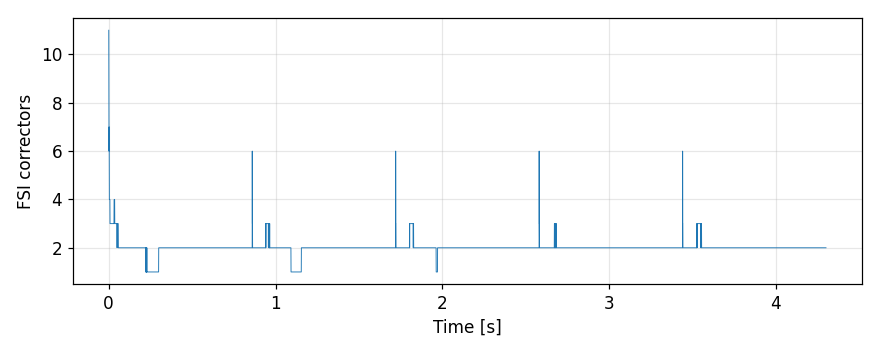
The number of FSI correctors per time step is recorded by fsiConvergenceData in postProcessing/0/fsiConvergenceData.dat. The first time steps need up to 11 correctors; after that the coupling converges in about two correctors per time step on average, well within the permitted 30.
Animation
Video 1: Animation of the tutorial: the geometry, the fluid and wall meshes, the prestress passes, and the blood flow and wall motion over a cardiac cycle.
Running the Case
From the tutorial directory, run
./Allclean
./Allrun parallel
Allrun runs the three stages in order:
Allmesh -> prestress/Allrun -> solids4Foam (fluid-solid interaction)
The case is configured for 16 subdomains (system/decomposeParDict, its fluid and solid counterparts, and prestress/system/decomposeParDict); change numberOfSubdomains in all four to run on a different number of cores. Omit parallel to run in serial. The stages can also be run separately: for example, prestress/Allrun can be rerun with a different number of passes after Allmesh, without remeshing.
The case requires PETSc and cartesianMesh; if either is unavailable, Allrun exits without running. The mesh-generation workflow is not supported on foam-extend.
Run times
As a guide, the full tutorial (./Allrun parallel) took about 10 h 20 min of wall-clock time on 16 cores of an AMD EPYC 9684X:
Allmesh(cartesianMesh,extrudeMesh,createPatch,transformPoints,checkMesh): under 1 min.prestress/Allrun(15 passes): 2.5 min, with 40 s of solver time for the first pass and 4-8 s for each later pass.solids4Foamfluid-solid interaction, five cycles (4.3 s, 17,200 time steps): 10.3 h (37,000 s).decomposeParandreconstructParof the fluid-solid interaction case: under 1 min.
The fluid-solid interaction run takes about 2.2 s per time step, or about 2 h per cardiac cycle, with about two FSI correctors per time step. It writes 86 time directories of about 60 MB each, so the finished case takes about 5 GB of disk space; increase writeInterval in system/controlDict to reduce this.
Regression Test
The case includes a regressionTest.sh script:
./regressionTest.sh
Because the full case takes about ten hours, the script copies the case inputs to pulmonaryArteries/regressionTests/main/ and runs a shortened version there; the tutorial directory itself is untouched. The copy keeps the tutorial meshes, since coarser meshes degrade on this geometry, but runs three prestress passes in place of 15, stops the fluid-solid interaction run after five time steps (\(1.25\times10^{-3}\,\mathrm{s}\)), and runs on four processes in place of
- On four cores it takes about nine minutes.
The following are then checked, against stored reference values within loose tolerances where a value is compared:
maxMag(D)inprestress/prestressHistoryfalls with each pass, and matches the reference for the first and last passes,- every FSI time step converges within
nOuterCorrcorrectors, - the prestressed wall stays near the imaged geometry: its largest displacement over the five steps is well below that of the unprestressed wall under the same pressure,
- the largest
innerWalldisplacement component frompostProcessing/0/solidDisplacementsinnerWall.dat, - the probe pressure from
postProcessing/pressureProbe/fluid.
Pass --check-only to re-check an existing regression run without re-running the case. If PETSc or cartesianMesh is unavailable, Allrun exits silently and the script skips the checks rather than reporting a failure. Like cerebralAneurysm, the test is run by hand rather than from tutorials/Alltest-regression.
References
- Yevtushenko, P., Kuehne, T., Bruening, J., & Goubergrits, L. (2025). A Simulation-Based Comparison of Human, Porcine and Ovine Pulmonary Artery Hemodynamics. Evaluating the Suitability of Large Animal Models for Endopulmonary Device Evaluation from a Hemodynamics Point of View. Cardiovascular Engineering and Technology, 16(6), 688–702. https://doi.org/10.1007/s13239-025-00803-z
- Whitty, J. P. M., Wain, R. a. J., Fsadni, A., Simo, J., & Francis, J. (2016). Computational Non-Newtonian Hemodynamics of Small Vessels. Journal of Bioinformatics Computational and Systems Biology, 1(1), 103.
- Lungu, A., Wild, J. M., Capener, D., Kiely, D. G., Swift, A. J., & Hose, D. R. (2014). MRI model-based non-invasive differential diagnosis in pulmonary hypertension. Journal of Biomechanics, 47(12), 2941–2947. https://doi.org/10.1016/j.jbiomech.2014.07.024
- Yang, W., Dong, M., Rabinovitch, M., Chan, F. P., Marsden, A. L., & Feinstein, J. A. (2019). Evolution of hemodynamic forces in the pulmonary tree with progressively worsening pulmonary arterial hypertension in pediatric patients. Biomechanics and Modeling in Mechanobiology, 18(3), 779–796. https://doi.org/10.1007/s10237-018-01114-0
- M. W. Gee, C. Förster, and W. A. Wall, "A computational strategy for prestressing patient-specific biomechanical problems under finite deformation," International Journal for Numerical Methods in Biomedical Engineering, 26(1), 52-72 (2010). https://doi.org/10.1002/cnm.1236.
- Ž. Tuković, M. Bukač, P. Cardiff, H. Jasak, and A. Ivanković (2019). "Added Mass Partitioned Fluid–Structure Interaction Solver Based on a Robin Boundary Condition for Pressure." In: J. Nóbrega and H. Jasak (eds), OpenFOAM®. Springer, Cham. https://doi.org/10.1007/978-3-319-60846-4_1.
- P. Cardiff, D. Armfield, Ž. Tuković, and I. Batistić, "A Jacobian-Free Newton-Krylov Method for Cell-Centred Finite Volume Solid Mechanics," International Journal for Numerical Methods in Engineering, 127(3), e70268 (2026). https://doi.org/10.1002/nme.70268.
- Azadani AN, Chitsaz S, Matthews PB, Jaussaud N, Leung J, Ge L, Tseng EE. Regional mechanical properties of human pulmonary root used for the Ross operation. J Heart Valve Dis. 2012 Jul;21(4):527-34. PMID: 22953683.