Spherical cavity under uniaxial tensions: sphericalCavity
Prepared by Philip Cardiff and Ivan Batistić
Tutorial Aims
- Demonstrate how to perform a 3D linear-static stress analysis in solids4foam
- Demonstrate the process of meshing using the Gmsh meshing utility, with optional conversion to a polyhedral mesh using the OpenFOAM
polyDualMeshutility - Demonstrates using the solids4foam solid solver based on the PETSc SNES nonlinear solver
Case Overview
This classic 3-D problem consists of a spherical cavity with radius $a = 0.2$ m (Figure 1) in an infinite, isotropic linear elastic solid ($E = 200$ GPa, $\nu = 0.3$). Far from the cavity, the solid is subjected to a tensile stress $\sigma_{zz} = T = 1$ MPa, with all other stress components zero. The analytical expressions for stress are derived by Southwell and Gough [1], while expressions for displacement are derived by Goodier [2]. The problem is characterised by a localised stress concentration near the cavity on the plane perpendicular to the loading, which drops off rapidly away from the cavity. The computational solution domain is taken as one-eighth of a $1 \times 1 \times 1$ m cube aligned with the Cartesian axes, with one corner at the sphere's centre. The problem is axisymmetric but is analysed here using a 3-D domain. The analytical tractions are applied at the far boundaries of the domain to mitigate the effects of finite geometry. They are defined with analyticalSphericalCavityTraction boundary conditions, which require geometry (cavity radius), loading (far-field traction), and material properties (Poisson's ratio):
    patch
    {
        type            analyticalSphericalCavityTraction;
        farFieldTractionZ 1e6;
        cavityRadius    0.2;
        nu              0.3;
        value           uniform (0 0 0);
    }
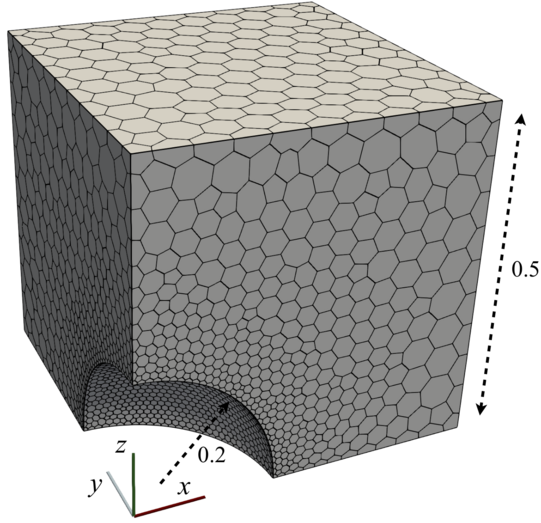
Figure 1: Spherical cavity case geometry and polyhedral mesh (4 555 cells), as produced by the optional poly mesh option.
Expected Results
The analytical expressions for the stress distributions around the cavity, first derived by Southwell and Gough [1], are:
\[\sigma_{rr} = \frac{T}{14 - 10\nu} \frac{a^3}{R^3} \left[ 9 - 15\nu - 12 \frac{a^2}{R^2} - \frac{r^2}{R^2} \left( 72 - 15\nu - 105 \frac{a^2}{R^2} \right) + 15 \frac{r^4}{R^4} \left( 5 - 7 \frac{a^2}{R^2} \right) \right],\] \[\sigma_{\theta\theta} = \frac{T}{14 - 10\nu} \frac{a^3}{R^3} \left[ 9 - 15\nu - 12 \frac{a^2}{R^2} - 15 \frac{r^2}{R^2} \left( 1 - 2\nu - \frac{a^2}{R^2} \right) \right],\] \[\sigma_{zz} = T \left[ 1 - \frac{1}{14 - 10\nu} \frac{a^3}{R^3} \left\{ 38 - 10\nu - 24 \frac{a^2}{R^2} - \frac{r^2}{R^2} \left( 117 - 15\nu - 120 \frac{a^2}{R^2} \right) + 15 \frac{r^4}{R^4} \left( 5 - 7 \frac{a^2}{R^2} \right) \right\} \right],\] \[\sigma_{zr} = \frac{T}{14 - 10\nu} \frac{a^3 z r}{R^5} \left[ -3(19 - 5\nu) + 60 \frac{a^2}{R^2} + 15 \frac{r^2}{R^2} \left( 5 - 7 \frac{a^2}{R^2} \right) \right].\]where $a$ is the hole radius, $T$ is the distant stress applied in the $z$ direction, $\nu$ is the Poisson's ratio, $r^2 = x^2 + y^2$ is the cylinderical radial coordinate, $R^2 = r^2 + z^2$ is the spherical radial coodinate, and $x$, $y$, $z$ are the Cartesian coordinates.
The displacement distributions were later derived by Goodier [2]: $$ u_r = -\frac{A}{r^2} - \frac{3B}{r^4}
- \left[ \frac{5-4\nu}{1-2\nu} \frac{C}{r^2}-9\frac{B}{r^4} \right]\cos (2\theta), $$
where the constants $A$, $B$ and $C$ are defined as follows: \(\frac{A}{a^3} = -\frac{T}{8\mu}\frac{13-10\nu}{7-5\nu}, \qquad \frac{B}{a^5} = -\frac{T}{8\mu}\frac{1}{7-5\nu}, \qquad \frac{C}{a^3} = -\frac{T}{8\mu}\frac{5(1-2\nu)}{7-5\nu}.\) and $\mu$ is the shear modulus.
The analytical solution is generated alongside solution fields using the function object sphericalCavityAnalyticalSolution located in the system/controlDict, where one needs to input geometry, loading and material data:
functions
{
    cavityAnalytical
    {
        type sphericalCavityAnalyticalSolution;
        farFieldTractionZ 1e6;
        cavityRadius 0.2;
        E 200e9;
        nu 0.3;
        cellDisplacement yes;
        pointDisplacement no;
        cellStress yes;
        pointStress no;
    }
}
The function object writes the analytical displacement and stress fields analyticalD and analyticalCellStress, and the difference fields DDifference and cellStressDifference, in the time directories.
The distribution of $zz$-component of stress field (sigma[ZZ]) is shown in Figure 2.
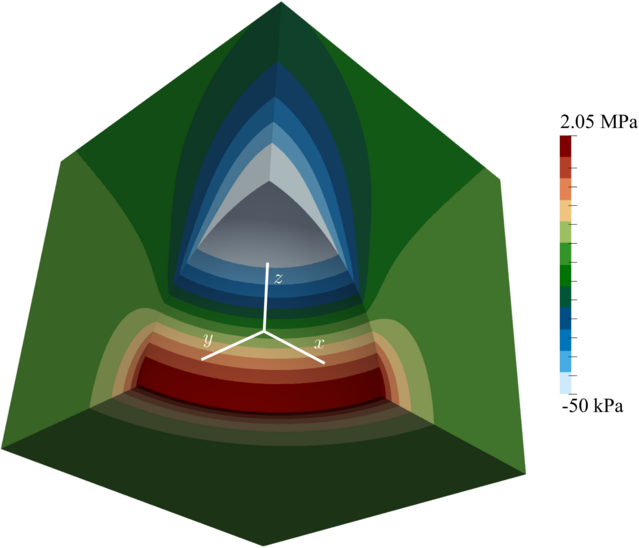
Figure 2: $\sigma_{zz}$ stress distribution.
Running the Case
The tutorial case is located at solids4foam/tutorials/solids/linearElasticity/sphericalCavity. The case can be run using the included Allrun script. The Allrun script optionally takes a first argument that specifies the solution approach:
./Allrun             # Defaults to the PETSc SNES second-order approach [3]
./Allrun segregated  # Segregated second-order approach
./Allrun highOrder   # PETSc SNES high-order approach [4]
and an optional second argument that specifies the mesh type:
./Allrun petscSnes tet   # Defaults to the tetrahedral mesh
./Allrun petscSnes poly  # Polyhedral (dual) mesh
The Allrun script starts by updating the files in the case to match the selected approach; the following files are updated: constant/solidProperties, system/fvSchemes, and system/fvSolution. Subsequently, the tutorial-local library in the src directory is compiled, and the unstructured tetrahedral mesh is created using the Gmsh meshing utility. If the poly mesh type is selected, the tetrahedral mesh is then converted to its dual polyhedral representation using the OpenFOAM polyDualMesh utility:
   # Create mesh with gmsh
    solids4Foam::runApplication gmsh -3 -format msh2 sphericalCavity.geo
    solids4Foam::runApplication gmshToFoam sphericalCavity.msh

    if [[ "$MESH" == "poly" ]]
    then
        solids4Foam::runApplication polyDualMesh 30 -overwrite
        solids4Foam::runApplication combinePatchFaces 45 -overwrite
    fi

    solids4Foam::runApplication changeDictionary
The case is currently only works with the COM version of OpenFOAM!
Here, the linearGeometryTotalDisplacement solid solver can adopt one of three solution approaches:
segregated: the standard segregated solution procedure, where each displacement component equation is solved separately using second-order spatial discretisation.petscSnes: the PETSc SNES nonlinear solver, using the same second-order spatial discretisation. The Jacobian-free Newton-Krylov approach is typically faster than the segregated approach, as examined in Cardiff et al. (2026) [3].highOrder: the PETSc SNES nonlinear solver using high-order spatial discretisation for the residual.