Contact patch test: contactPatchTest
Prepared by Ivan Batistić
Tutorial Aims
- Demonstrate that a uniform pressure field can be transmitted across a non-conformal contact interface;
- Examine the solver performance when solving contact problems in small deformation settings.
Case Overview
The contact patch test is designed to check can a uniform pressure field can be transmitted across a non-conformal contact interface. There are different versions of the patch test in the literature [1, 2]; here patch test proposed in [3] is considered. The lower block is fixed at the bottom surface, whereas the upper block has a prescribed displacement \(\Delta = 0.01\) m at its top surface (see Figure 1). Both blocks have the same dimensions, \(1\) m width and \(0.5\) m height, and the same material properties, Young's modulus \(E = 1 × 10^6\) Pa and zero Poisson's ratio \(\nu = 0\). Gravitation effects are neglected, and there are no body forces. The problem is solved as static, using one loading increment. At the contact interface, frictionless contact is considered, i.e. \(\mu=0\).
![Figure 1: Problem geometry (dimensions in m) [4]](/tutorials/more-tutorials/solid-mechanics/linearElasticity/images/contactPatchTest-geometry.png)
Figure 1 - Problem geometry (dimensions in m) [4]
Expected Results
- Under plane strain conditions, the analytical solution to the problem is
[1]: \(\sigma_{x} = \tau_{xy}=0\qquad \sigma_{y} = \dfrac{E}{1-\nu^2}\Delta \qquad \sigma_z = \nu \sigma_y.\)
where \(E\) is Young's modulus, \(\nu\) Poisson's ratio and \(\Delta\) prescribed displacement of upper block top surface.
For the considered case with \(\nu=0\), there are no \(\sigma_x\) and \(\sigma_z\) stresses. If one wants to set \(\nu > 0\) the above equation can be used only if the bottom surface of the lower block is allowed to deform freely in the tangential direction. Here the bottom surface of the lower block is held fixed as there is no displacement in the \(x\) direction.
The analytical solution is generated alongside solution fields using the contactPatchTestAnalyticalSolution function object compiled when running the > ./Allrun script. Function object inputs are located in controlDict where one needs to specify the upper block top surface vertical displacement and material data:
functions
{
    analyticalSolution
    {
        type    contactPatchTestAnalyticalSolution;

        // Upper block top surface vertical displacement
        displacement   0.01;

        // Young's modulus
        E       1e6;

        // Poisson's ratio
        nu      0.0;
    }
}
The function object writes the analytical stress tensor field analyticalStress and the scalar relative error field relativeError in the time directories.
Figure 2 shows the distribution of the relative error field \(e\). The relative error (in percentages) is defined as:
\[e(\%)=\dfrac{\left| \sigma_y - \sigma_y^{analytical} \right|}{\left|\sigma_y^{analytical}\right|} \cdot 100.\]One can see that the error distribution is uniform, meaning that the solidContact boundary condition can correctly transmit a spatially uniform pressure field across a flat non-conformal interface in complete contact. Results for Fig. 2 are obtained using foam-extend 4.1 and linearGeometryTotalDisplacement solver, with the normal penalty scale set to \(f_n^{scale}=5\).
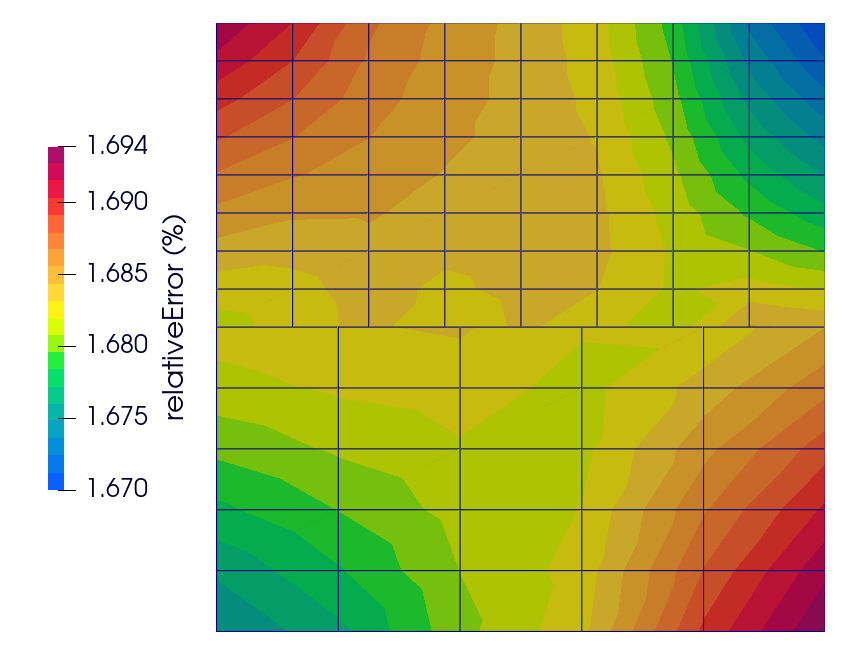
Figure 2 - Distribution of the relative error
Running the Case
The tutorial case is located at solids4foam/tutorials/solids/linearElasticity/contactPatchTest. The case can be run using the included Allrun script, i.e. > ./Allrun. In this case, the Allrun script compiles the tutorial-local library in the src directory, creates the mesh using blockMesh (> blockMesh), and runs the solids4foam solver (> solids4Foam).
Verification study
The opt-in verification directory reproduces the two formulation variants formerly stored in the separate solid-benchmarks repository. Its Allverify driver runs both linearGeometryTotalDisplacement and unsLinearGeometry on isolated copies of this case and checks their transmitted stress against the analytical solution. This study is not run by the standard tutorial regression suite.
References
[1] Wriggers, P.. Computational contact mechanics. Vol. 2. Berlin: Springer, 2006.
[3] Crisfield MA. Re-visiting the contact patch test. Int J Numer Methods Eng. 2000.