3-D Dynamic Cantilever
Tutorial Aims
This tutorial demonstrates how to:
- simulate the large-deformation vibration of a three-dimensional cantilever
- create a beam mesh and rotate it into its initial vertical configuration
- apply a time-dependent end force and zero end moment
- use the implicit Newmark time-integration scheme
- compare mesh and time-step sensitivity against reference solutions
- extract displacement, force, convergence and energy histories
The case is the first benchmark presented in the beamFoam paper.
Prerequisites
- A compiled beamFoam installation
- A sourced, supported OpenFOAM.com environment
- gnuplot with the
pdfcairoterminal for generating the supplied plots - ParaView for visualising the deformed beam
The default case uses OpenFOAM's implicit Newmark scheme, a time step of 0.001 s, and 20 beam segments.
Problem Description
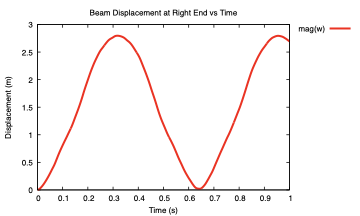
A cantilever column with a square cross-section is clamped at its lower end and subjected to a sudden constant force at its upper end. The force acts from t = 0 s until the simulation ends at t = 1 s, producing large three-dimensional deformation and vibration.
The benchmark compares the one-dimensional beamFoam model against detailed three-dimensional solids4Foam and ABAQUS solutions.
| Property | Value |
|---|---|
| Length | 2 m |
| Cross-section | 0.2 m x 0.2 m square |
| Young's modulus | 15.293 MPa |
| Shear modulus | 5.882 MPa |
| Poisson's ratio | approximately 0.3 |
| Density | 1000 kg/m^3 |
| Applied end force | (2000 2000 0) N |
| Default mesh | 20 beam segments |
| End time | 1 s |
| Default time step | 0.001 s |
The first bending period is approximately 1 s. The paper recommends resolving this period with at least 20 to 50 points, corresponding to a time step of approximately 0.02 s or smaller.
Case Setup
Beam Geometry and Material
The beam definition is stored in constant/beamProperties:
beamModel coupledTotalLagNewtonRaphsonBeam;

beams
(
    beam_0
    {
        crossSectionModel rectangle;

        rectangleCrossSectionModelDict
        {
            b 0.2;
            h 0.2;
            nx 1;
            ny 1;
        }

        length      2;
        nSegments   20;
        E           15.293e6;
        G           5.882e6;
        rho         1000;
    }
);
createBeamMesh initially creates the beam along the global x-axis. The Allrun script then rotates beam_0 by 90 degrees about the negative y-axis:
setInitialPositionBeam \
    -cellZone beam_0 \
    -translate '(0 0 0)' \
    -rotateAngle '((0 -1 0) 90)'
Boundary Conditions and Loading
The left patch represents the clamped lower end:
0/W:fixedValuedisplacement0/Theta:fixedValuerotation
The right patch represents the loaded upper end:
0/W:forceBeamDisplacementNR, readingconstant/timeVsForce0/Theta:momentBeamRotationNR, reading the zero-moment history inconstant/timeVsMoment
The applied force history is:
(
    (0 (2000 2000 0))
    (1 (2000 2000 0))
)
Time Integration and Output
system/fvSchemes selects the implicit Newmark method for the first- and second-time derivatives. system/controlDict defines deltaT, the end time, write frequency and the following function objects:
beamDisplacements: displacement history at therightpatchbeamForcesMoments: force and moment history at theleftpatchbeamConvergenceData: nonlinear convergence historybeamEnergyData: internal, kinetic and total energy histories
Running the Tutorial
From this tutorial directory:
./Allclean
./Allrun
The script performs:
createBeamMeshsetInitialPositionBeambeamFoamgnuplot allPlots.gnuplot
The main generated files are:
log.createBeamMeshlog.setInitialPositionBeamlog.beamFoamdisplacementPlot.pdfenergyPlot.pdfpostProcessing/0/beamDisplacements_right.datpostProcessing/0/beamEnergyData.dat
Post-Processing
To inspect the deformed column:
touch case.foam
paraview case.foam
Apply Warp By Vector using pointW. The upper end should undergo a large oscillatory displacement and can fall below its initial base level during the motion.
displacementPlot.pdf shows the displacement magnitude at the loaded end. energyPlot.pdf shows the internal, kinetic and total energy histories.
Expected Results
The paper reports that:
- approximately four Newton iterations are required per time step
- even a five-segment beam gives a response close to the reference results
- the 20-segment result converges closely to solids4Foam and ABAQUS
- Newmark captures the oscillatory response more accurately than backward Euler for a given time step
- time steps of
0.01 sand0.001 sclosely match the reference response
Reference displacement histories from solids4Foam and ABAQUS are supplied in solidPointDisplacement_pointDisp.dat and cantilever_abaqus_50percent.txt.
Video Demonstration
The execution times reported in the paper were obtained on an Apple M1 Pro and should be treated as comparative reference values rather than acceptance criteria:
| Model | Execution time |
|---|---|
| beamFoam, 5 segments | 0.89 s |
| beamFoam, 10 segments | 1.01 s |
| beamFoam, 20 segments | 1.26 s |
| solids4Foam JFNK | 12156 s |
| ABAQUS C3D8 | 9240 s |
Mesh Sensitivity Study
Run:
./runSweep.sh
The script runs meshes with 5, 10, 20 and 40 segments. It writes:
timing_summary.txt- displacement histories under
dispResults/ dispPlotVaryingMesh.pdf
The script modifies nSegments in constant/beamProperties and leaves the last tested value in place. Restore the default value of 20 before running the standard case again.
Time-Step Sensitivity Study
Keep the Newmark scheme selected in system/fvSchemes, then run:
./runTimeSweep.sh
The script tests deltaT = 0.1, 0.05, 0.01 and 0.001 s. It writes:
dt_timing_summary.txt- displacement histories under
dispResultsTime/ dispPlotVaryingDT.pdf
The script modifies deltaT and writeInterval in system/controlDict and leaves the last tested values in place.
To investigate backward Euler, change both defaults in system/fvSchemes from Newmark to Euler before running the sweep. Coarse Euler time steps introduce substantial numerical damping.
Troubleshooting
- If
createBeamMeshorbeamFoamis not found, source OpenFOAM and rebuild beamFoam. - If the beam remains horizontal, inspect
log.setInitialPositionBeamfor errors. - If plotting fails, confirm that gnuplot supports the
pdfcairoterminal. The solver results remain available underpostProcessing/. - Run
./Allcleanbefore repeating the standard case after a sensitivity study.
References
- Bali, S., Taran, A., Tuković, Ž., Pakrashi, V., and Cardiff, P. (2025). beamFoam: A Cell-Centred Finite Volume Solver for Nonlinear Geometrically-Exact Beams in OpenFOAM. OpenFOAM Journal, 5, 180-210.
- Cardiff, P., et al. (2025). A Jacobian-Free Newton-Krylov Method for Cell-Centred Finite Volume Solid Mechanics.