Wobbly Newton: wobblyNewton
Prepared by Philip Cardiff and Ivan Batistić
Tutorial Aims
- Demonstrate a transient small-strain linear elastic analysis on a complex geometry with an unstructured mesh obtained using
cfMesh; - Demonstrate the use of
surfaceToPatchfor extracting patches corresponding to the provided.stlfiles.
Case Overview
This case considers a flexible Newton-shaped body attached to a fixed base. The geometry is supplied by the newtonDecimated.stl surface file. The volume mesh is generated using the cfMesh cartesianMesh utility, with the meshing settings prescribed in system/meshDict.
The body is modelled as linear elastic rubber using the small-strain assumption, with density \(\rho = 1500\) kg/m\(^3\), Young's modulus \(E = 1\) MPa, and Poisson's ratio \(\nu = 0.3\). The flat base of the statue has a fixed displacement boundary condition, and the remaining surfaces are traction-free. The case is solved as a transient problem from \(t = 0\) s to \(t = 0.36\) s using a time-step of \(\Delta t = 0.01\) s. The body force is set through the g field as \((0, 9.81, 0)\) m/s\(^2\).
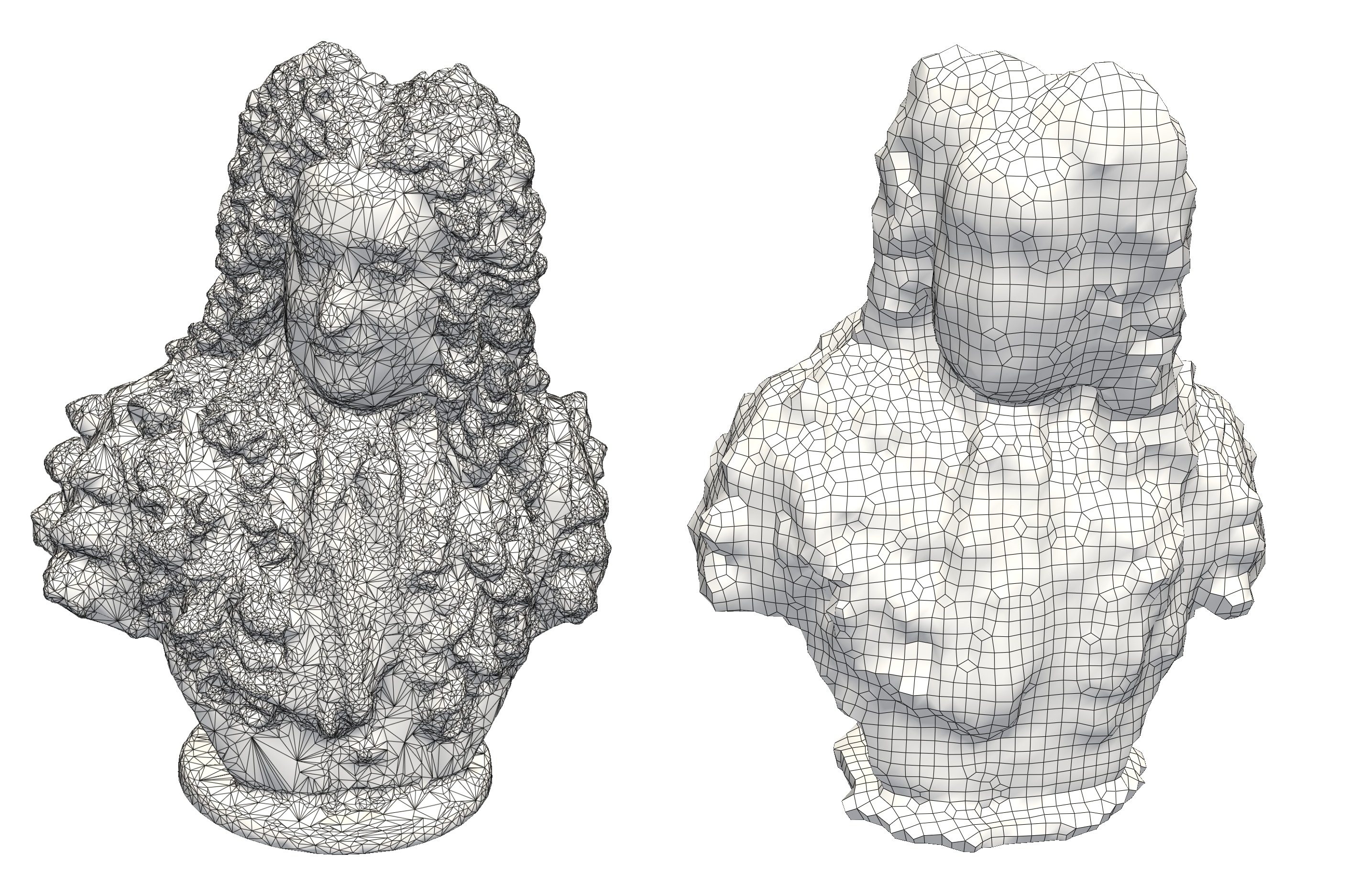 Figure 1: Input geometry (left) and computational mesh (right)
The mesh density does not capture all geometry features, which is acceptablefor this demonstration. For real cases, a finer decimated surface and a finervolume mesh should be used.
Expected Results
This case does not have an analytical solution for direct quantitative comparison. The expected response is qualitative: the fixed base constrains the lower part of the geometry while the flexible Newton-shaped body undergoes a transient oscillating displacement under the applied gravitational (body) force.
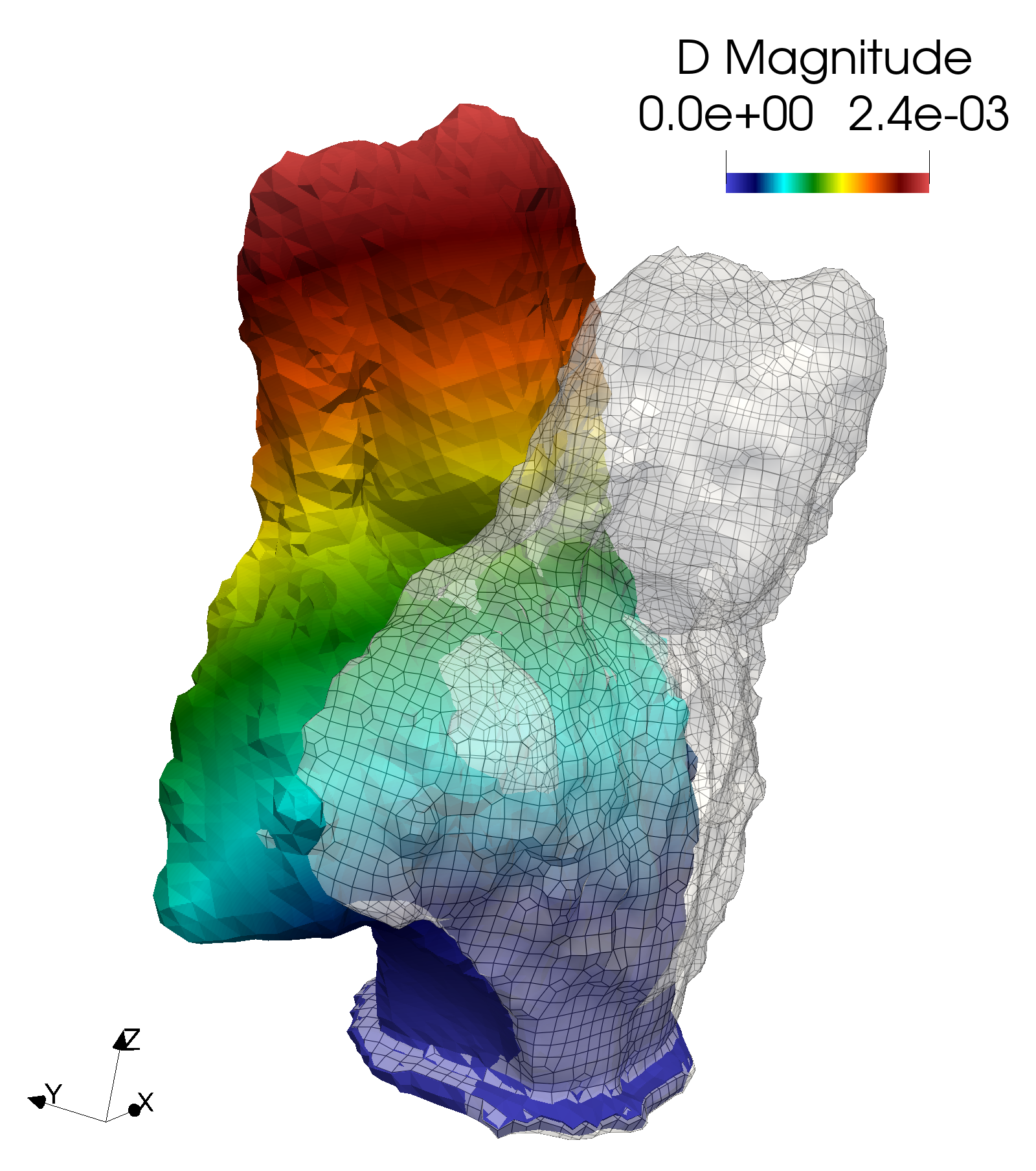 Figure 2: Deformed geometry coloured by displacement magnitude; deformation is scaled
The solidPointDisplacement function object records the displacement of a point close to \((0.0408, 0.0048, 0.0929)\). The output is written to postProcessing/0/solidPointDisplacement_pointDisp.dat. The monitored point displacement can be used to check the transient response.
Running the Case
The tutorial case is located at solids4foam/tutorials/solids/linearElasticity/wobblyNewton.
The case is solved with the PETScSNES solution algorithm. By default, the PETSc options are read from petscOptions.mf.hypre, which uses a matrix-free Newton method with a HYPRE preconditioner.
Initially, this case was a demonstration of vertex-centred discretisation; therefore, system/fvSchemes also contains time discretisation schemes used by the vertex-centred solid model.
This case requires OpenFOAM.com, PETSc, and the cartesianMesh utility. It is skipped by the Allrun script if PETSC_DIR is not set or if cartesianMesh is not available.
The case can be run in serial using:
./Allrun
The script converts the case format if required, creates the mesh using cartesianMesh, creates the base patch using surfaceToPatch, and then runs the solids4Foam solver.
The case can also be run in parallel using:
./Allrun parallel
In parallel, the case is decomposed using decomposePar, solved in parallel, and reconstructed using reconstructPar.